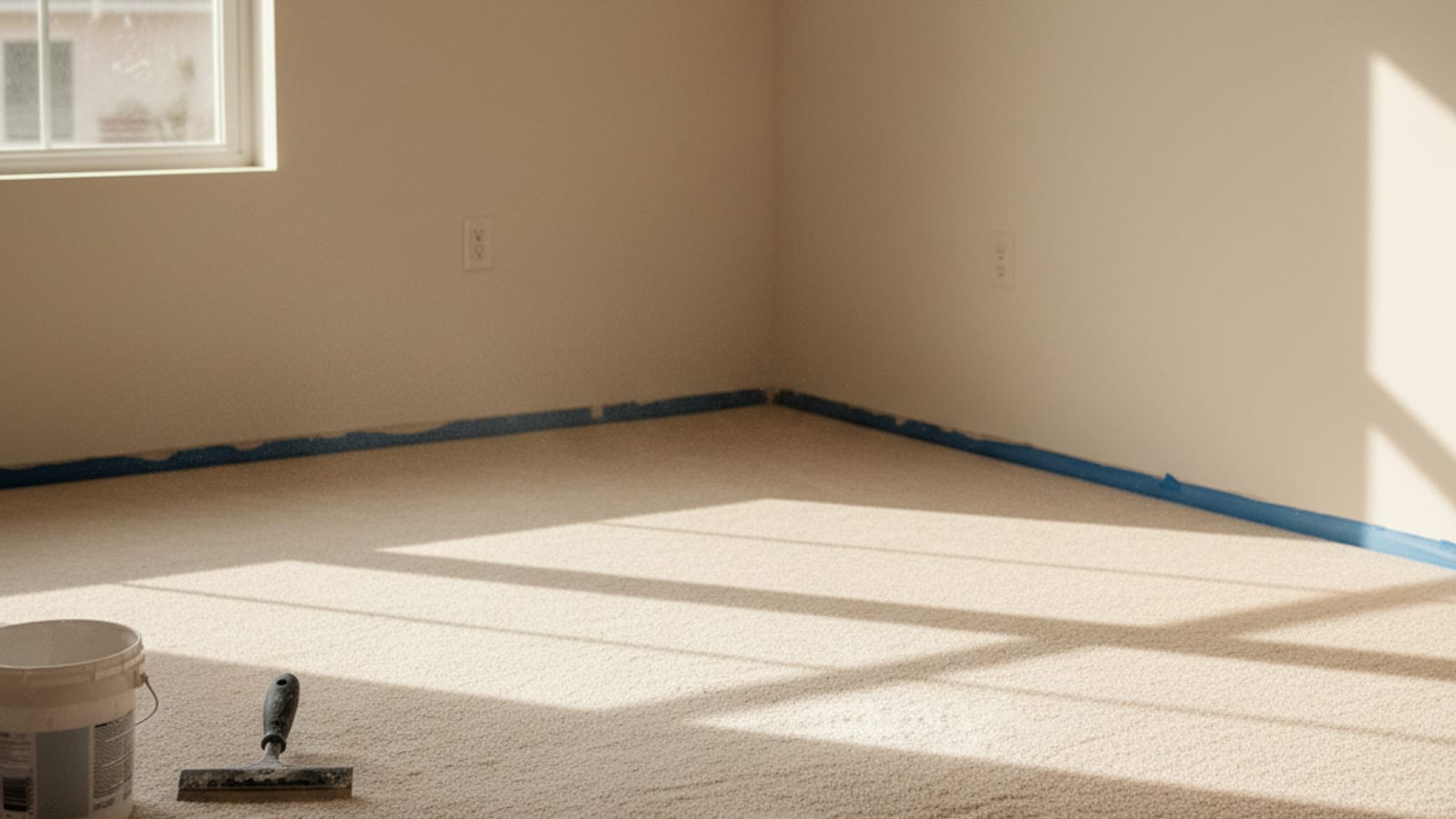
If you’ve just finished a remodel or moved into new construction, your carpet has a specific problem you can’t solve by vacuuming. Drywall dust is unusually bad for carpet fiber, and the only way to get it out is a staged cleaning that most standard residential services skip. Here’s why, and what to look for.
Why drywall dust is worse than regular dust
Drywall (gypsum board) dust is fine-grained calcium sulfate. Three traits make it uniquely damaging to carpet:
1. It’s fine enough to settle into the backing
Particles are 1–5 microns. For reference, a human hair is 70–100 microns wide. Drywall dust falls through carpet face yarn and lodges in the primary and secondary backing where no household vacuum can reach it.
2. It’s abrasive
When ground into carpet by foot traffic, gypsum particles act like fine sandpaper against carpet fiber. Measurable fiber wear happens within months. Carpet in a post-construction room that wasn’t deep-cleaned often shows visible pile damage by year 2.
3. It reacts with moisture
Calcium sulfate hardens when it gets damp, and even humidity is enough. Once drywall dust has been walked into carpet and the home’s normal humidity has gone through a cycle or two, the dust has formed microscopic hard bonds with the fiber. A DIY vacuum pass at this stage pulls up almost nothing, because the dust is bonded to the fiber.
The post-construction cleaning protocol
What we do that’s different from a normal carpet cleaning job:
Step 1: HEPA-filtered pre-vacuum
Not a standard vacuum, but a commercial HEPA backpack. The HEPA filtration matters because drywall dust is fine enough to pass straight through a residential vacuum bag and redistribute. Without proper filtration, you’re just moving the problem around.
The technician wears an N95 mask and safety glasses for this step. We vacuum every room, every baseboard line, every corner, every stair edge.
Step 2: Baseboard and hard-surface wipe
Before we wet the carpet, we wipe baseboards, window sills, and any hard surfaces that collected dust. This prevents the pre-treatment from creating a slurry that then re-deposits into the carpet.
Step 3: Pre-treatment with alkaline booster
Alkaline pre-treatment helps release the fine mineral soil that’s bonded to fiber. We let it dwell for 10–15 minutes. That’s not standard on a regular clean, but it’s necessary for drywall dust.
Step 4: Hot-water extraction (two passes)
Extraction pass 1 pulls the pre-treatment and the released dust. Pass 2 is a clear-water rinse to remove any remaining alkaline residue. Both passes in opposite directions to fully flush the backing.
Step 5: Corner and edge detail
Drywall dust concentrates at baseboards, door thresholds, and in corners where it drops out of the air. We hand-clean these with a crevice tool.
Step 6: Dry-only final vacuum
After the carpet is fully dry (6–8 hours later, usually next-day visit), we run a final HEPA vacuum to pick up any residual dust that wicked back up during drying.
This last step is what separates a real post-construction clean from a cheap one. Without it, you’ll see surface dust reappear on the first humid day.
Why a standard residential clean isn’t enough
A normal residential cleaning job is pre-vacuum, extraction, exit. On post-construction carpet, this leaves about 40% of the drywall dust still in the backing. It looks clean for about a week, then the dust settles back into the pile.
If you’ve had post-construction cleaning done and the carpet looks dusty again within a week, you got a standard clean on a job that needed the post-construction protocol.
What post-construction carpet actually needs
The rule we follow: every post-construction carpet cleaning is really two visits.
Visit 1: The full protocol (HEPA vacuum, pre-treatment, two extraction passes). This is the deep clean.
Visit 2: Two to four weeks later. Another HEPA pre-vacuum and a follow-up extraction on traffic-lane areas. This catches the residual dust that has wicked to the surface and the new dust settled during the interval.
Without Visit 2, the carpet won’t look as clean as it should by month 2.
When to schedule
For new construction:
- After all trades are done (including touch-up paint)
- Before you move furniture in
- Before any rugs go down
For remodels with carpet that stayed in place:
- After all drywall and paint is finished
- After any final punch-list work
- Allow 1 week for settled dust to fully deposit before cleaning
Trying to clean in the middle of construction is wasted money. New dust will land that afternoon.
Pricing considerations
Post-construction cleaning runs about 40–60% above standard residential cleaning because of the equipment, labor, and two-visit protocol.
Typical pricing for a 3-bedroom home:
- Standard cleaning: $199–289
- Post-construction cleaning (both visits): $349–499
Some contractors build this into the construction contract. If yours didn’t, ask, because it’s sometimes negotiable.
The other trades to coordinate
Post-construction carpet is just one piece. Common companion services:
Tile and grout
New tile grout should be sealed within 7 days of installation. Pre-seal cleaning with our tile tool prevents the new grout from absorbing future stains. See tile & grout page.
Upholstery
If any furniture was in the home during construction, it collected dust too. Single upholstery visit at the same time as carpet cleaning saves a trip fee. See upholstery page.
Duct cleaning
Highly recommended after any construction project. Drywall dust accumulates in HVAC ducts and redistributes whenever the system runs. We don’t do duct cleaning ourselves, but we can refer to a duct specialist.
A quick note on contractor cleanups
Some general contractors offer a “final clean” as part of construction. These are usually surface-only passes by a construction cleaning crew, not a professional carpet cleaner. They handle the visible stuff (vacuum, dust, mop) but not the extraction-level work on carpet.
If your contract includes “final cleaning,” that’s a separate service from what we do. It’s not a substitute for a real post-construction carpet cleaning.
How to know if your carpet actually got a proper clean
Two tests:
- Vacuum test at 2 weeks: run a good vacuum over the carpet. If visible dust comes out, the backing wasn’t extracted properly.
- Humid day test: on the first humid morning (or run a humidifier for a few hours), check the carpet. If it looks dusty again, residual dust was hydrated and re-surfaced.
A good post-construction clean passes both tests.
Schedule post-construction work
We run a specific post-construction schedule that accounts for:
- Two-visit protocol (first visit extended labor, second visit shorter)
- HEPA equipment and masks
- Specialized pre-treatment
- Coordination with your contractor’s punch-list timing
Call (858) 925-5546 with the general timeline of your construction and we’ll build the schedule backward from your move-in date.
Most post-construction jobs book 1–2 weeks out, and earlier scheduling lets us lock in the follow-up visit.