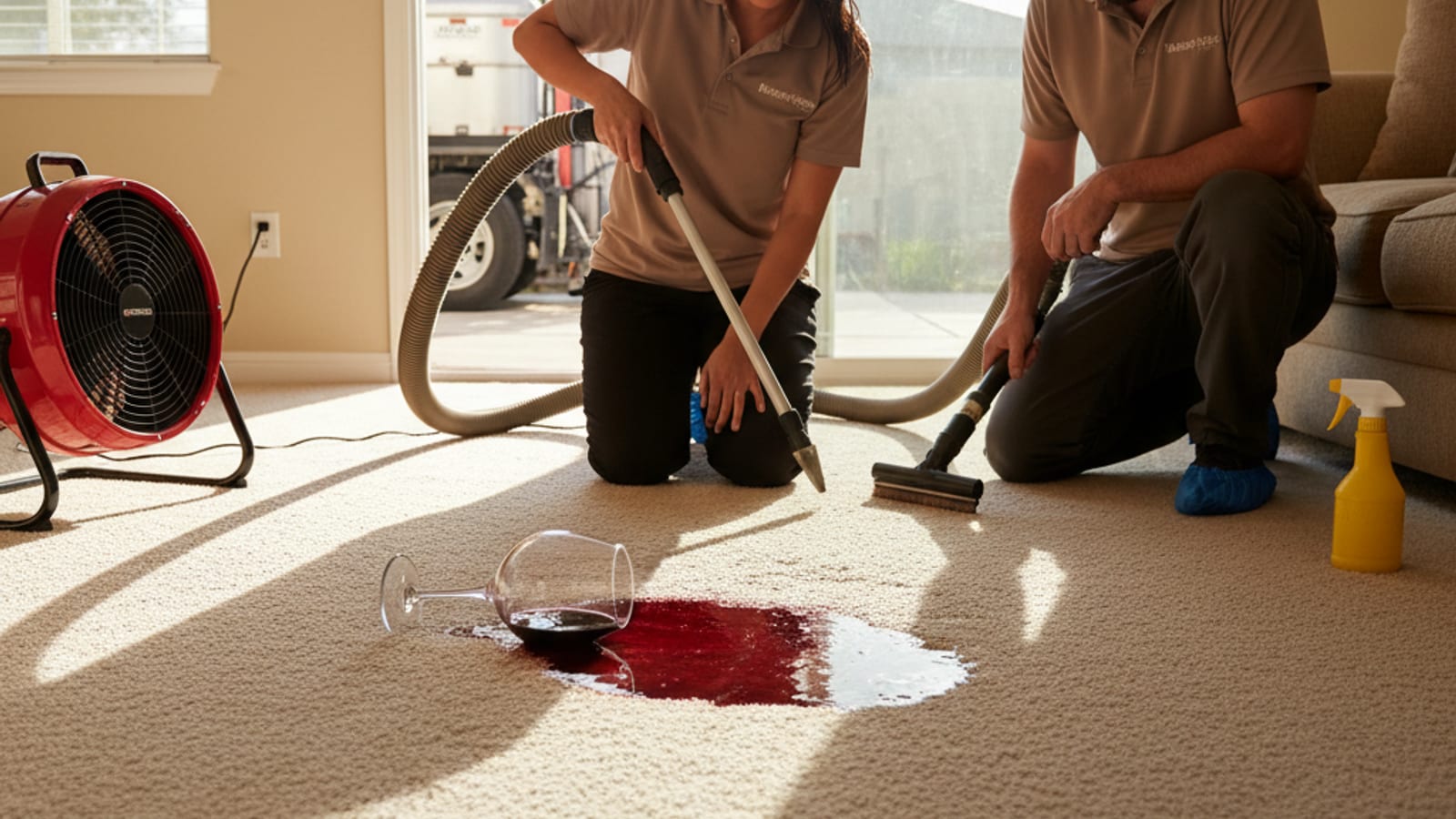
Red wine on light carpet is one of the two or three most panic-inducing spills. Good news: fresh red wine comes out reliably if you move fast and skip the home remedies that don’t work.
The 60-second triage
The moment it spills:
- Lift anything breakable. Glass, decorations, whatever’s on the carpet. You’ll be working in that area for the next 10 minutes.
- Blot, don’t rub. Grab a clean white towel (a tea towel, a handful of paper towels, a cloth diaper, anything absorbent and colorfast). Press straight down and hold for 10 seconds. Don’t scrub. Don’t wipe. Just press.
- Keep changing towels as they saturate. You’re absorbing the wine that’s still on the surface before it has a chance to bond to the fiber.
- Pour cold water on the spot (small amount, a few tablespoons). This dilutes the remaining wine and moves it back up toward the surface.
- Blot again. Press and hold. Change towels.
That’s the first 60 seconds. If you stop there and call us, 90% of our job is done.
What NOT to do
Before we get to the right products, here’s what to skip:
Salt
The “pour salt on it” trick is half-right. Salt does absorb some liquid. But the salt then gets walked into the carpet, attracts moisture, and can actually leave a light-colored residue that requires professional extraction to remove. Verdict: skip. Plain cold-water blot works just as well without the side effect.
Club soda
Club soda is slightly better than salt because it’s just carbonated water. Bubbles help lift the wine. But it’s no better than plain cold water for the effort. Verdict: fine if it’s what you have; not worth the errand.
White wine on red wine
Pouring white wine on a red wine stain does nothing chemistry-wise. You’re just adding more liquid. Verdict: drink the white wine while someone else cleans.
Hot water
Do not use hot water on a protein stain. Hot water cooks protein into fibers and sets the stain. Red wine contains some proteins (and tannins), so cold water only.
Hydrogen peroxide, bleach, Oxy spray
These strip dye. On a light carpet you can sometimes get away with it; on any colored or patterned carpet you’ll end up with a bleached spot you can’t undo. Verdict: don’t, especially on nylon or wool.
Carpet shampoo machine
A rental or DIY shampooer with detergent, run over a fresh red wine spot, usually sets the stain by soaking it deeper into the pad. The residue then bonds to the tannin. Verdict: skip until after the triage above.
What actually works on fresh red wine
Option 1: Dish soap + cold water
Mix 1 tablespoon of clear (not colored) dish soap with 2 cups of cold water. Dip a clean towel in, blot the stain from the outside in. Then blot with a dry towel. Rinse with a plain cold-water towel. Blot dry one more time.
Works about 80% of the time on fresh spills. The surfactant in dish soap releases the tannin from the fiber.
Option 2: Commercial red stain remover
Wine Away and OxiClean Carpet Spray are the two that actually work. Follow the bottle. For both, that means spray lightly, wait the recommended dwell time, then blot.
Careful with the OxiClean on wool. It’s oxidizer-based and can lighten natural wool. Spot-test in a closet.
Option 3: Baking soda paste (on a fully dried stain)
If you missed the window and the stain is now dry:
- Make a paste: 3 tablespoons baking soda + 1 tablespoon water.
- Apply to the stain, cover with a clean dry towel, weight it down.
- Wait 24 hours.
- Vacuum the dried paste.
This is a “maybe.” It works on about half of dried wine stains. If it doesn’t work, call a pro and don’t keep applying more.
Wool, silk, and antique rugs
If the spill is on a wool area rug, a silk rug, or a hand-knotted antique, stop at the blot step. Do not pour water (even cold), do not apply any cleaner, do not scrub. Call us. Wool and silk respond to specific pH-neutral chemistry that the home-remedy products don’t replicate. Getting it wrong on a $5,000 rug is a costly mistake.
Our wool-safe pretreatment, applied within 24 hours, removes fresh red wine from wool rugs reliably. See our rug cleaning page.
What’s different about an old red wine stain
A wine stain that dried more than 48 hours ago is harder. Tannins have bonded to the fiber and color has transferred. DIY removal from this point is difficult and often just partially successful.
Professional removal uses a tannin-specific spotter plus heat-transfer extraction. It works on about 85% of set red wine stains. If the fiber has been partially dye-stripped by a prior DIY attempt (bleach or hydrogen peroxide), the stain is permanent and the fix is either carpet patching or accepting it.
Honest take: we’ve had jobs where the original stain would have come out if the homeowner had called us first, but three rounds of DIY products locked it in. Call before you treat a stain that matters. We’ll do the 60-second phone consult for free.
How to keep wine on the menu
Some pragmatic prevention:
- Red wine Saturday is a dining-room activity. Reserve a small area rug or a washable table runner for wine nights.
- Keep a dedicated spot cleaner in the house. Bissell SpotBot, $150, lives in a closet. For any spill on carpet, you have a 30-second response tool.
- Scotchgard-class protector after a professional cleaning. Real stain protection buys you an extra 60 seconds in the moment. See carpet protector.
- Light-colored dining room carpet is a choice. If you entertain frequently with red wine, consider a darker tone or a patterned carpet in the dining area. Wool tends to release stains better than synthetic.
When it’s worth calling us immediately
Call, don’t try DIY first, if:
- It’s a wool or silk carpet
- The carpet is valuable or recently replaced
- The spill is larger than a cup
- It landed on an area rug (especially hand-knotted)
- You’ve already tried something and it didn’t work
Our spot-call rate for a single-stain visit is $79. Most spot jobs finish in 30 minutes. Compared to replacing carpet or living with a permanent stain, that’s cheap.
(858) 925-5546. We take emergency stain calls across all of San Diego County.