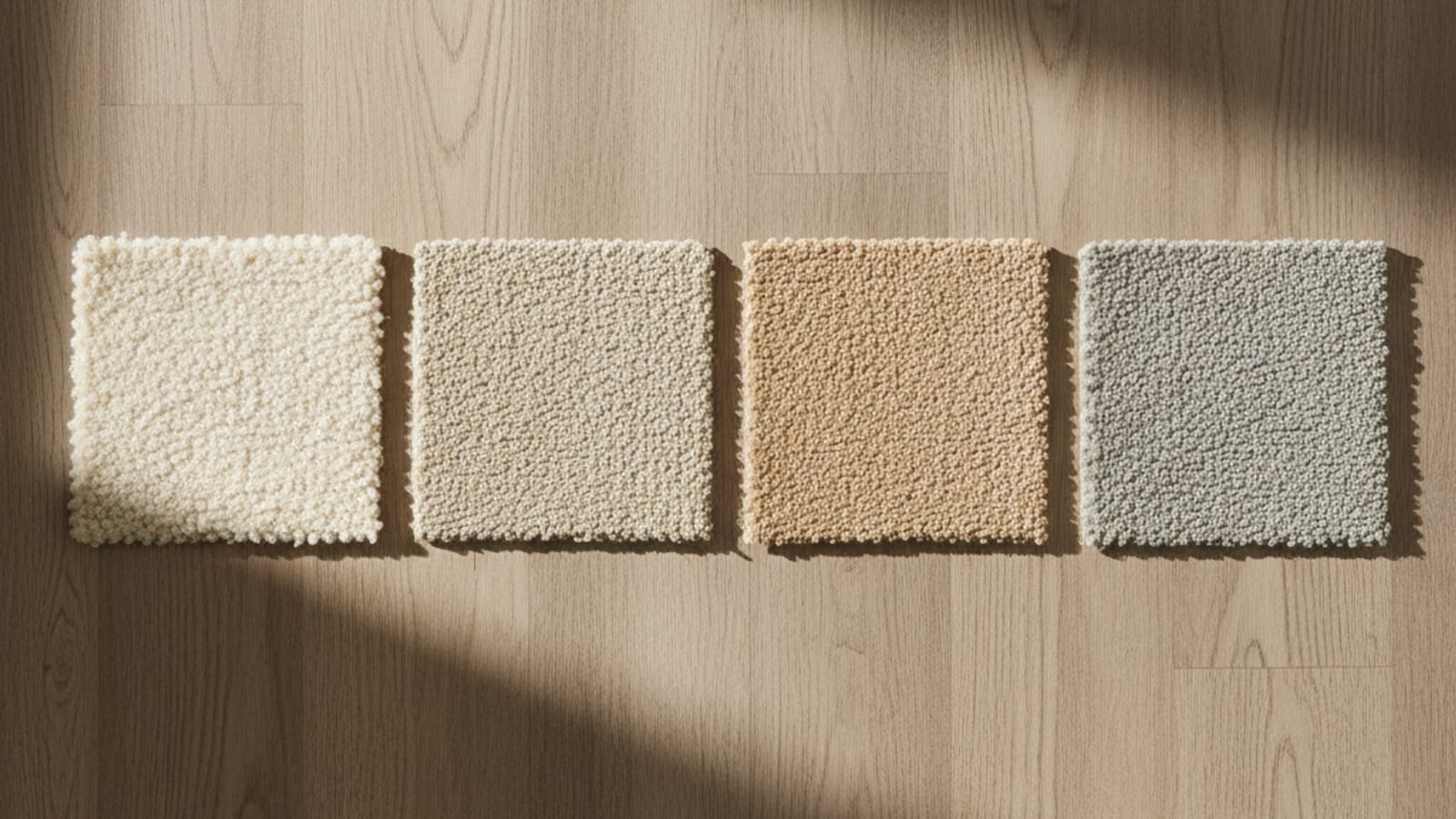
“What’s my carpet made of?” is a question most homeowners can’t answer. That’s normal. The invoice from your flooring installer probably didn’t highlight it. But the fiber type determines almost everything about how your carpet should be cleaned, how long it’ll last, and how it’ll respond to spills. Here’s the field guide.
The four main fiber types
Residential carpet in the US is almost entirely made from four fibers: nylon, polyester, olefin, or wool. Each has a characteristic profile.
Nylon (nylon 6 or nylon 6,6)
Share of US residential carpet: ~40% historically, declining to ~30% now Look and feel: durable, resilient, mid-softness Price: mid-to-high ($3–6/sq ft material)
The workhorse of American carpet for decades. Bounces back from foot traffic well, dyes beautifully (huge color range), and handles hot-water extraction great.
Cleaning: the easiest fiber to clean. Hot water, proper detergent, standard extraction: nylon tolerates everything we do. This is why manufacturer warranties on nylon are the strongest.
Lifespan: 12–15 years in a normal home with annual cleaning. Can stretch to 20 in a low-traffic area.
Watch out: older nylon can develop static buildup in dry conditions. Some inland homes notice this in late summer.
Polyester (PET)
Share of US residential carpet: ~35% now, growing Look and feel: very soft, slightly shinier than nylon Price: low-to-mid ($2–4/sq ft material)
The rising star of residential carpet. Made largely from recycled plastic bottles. Softer than nylon, more stain-resistant out of the box, cheaper.
Cleaning: takes hot-water extraction fine but is oleophilic, meaning it holds onto oils. Kitchens and dining rooms on polyester carpet often need a stronger pre-treatment for body-oil buildup in traffic lanes than nylon would.
Lifespan: 8–12 years. Doesn’t rebound from crushing as well as nylon, so the pile can flatten in traffic lanes over time.
Watch out: polyester that looks “tired” in the traffic lanes is usually crushed, not dirty. Cleaning won’t fully fix it. The fiber is permanently compressed.
Olefin (polypropylene)
Share of US residential carpet: ~20%, mostly low-end or commercial Look and feel: low pile, less plush, durable under abuse Price: low ($1.50–3/sq ft material)
The bulletproof option for high-traffic commercial, basements, and rental properties. Won’t absorb water, resists mildew, cheap.
Cleaning: the odd one out. Olefin is hydrophobic. It won’t absorb water-based cleaners well. It holds grease and oily soils tightly and releases them reluctantly. Traffic lanes on olefin carpet develop dark bands because the oil builds up in the fiber.
For olefin cleaning we often use a solvent-based pre-treatment, then extraction. Results are less dramatic than nylon. The carpet gets cleaner, but the dark traffic-lane appearance sometimes persists due to fiber crushing.
Lifespan: 5–10 years in residential use. Better in commercial environments where it’s built for it.
Watch out: olefin berber loops catch sharp objects and pull fibers. Keep pets trimmed and vacuum with care.
Wool
Share of US residential carpet: under 5%, mostly area rugs and high-end installs Look and feel: natural fiber feel, slightly lanolin-y, deep pile Price: high ($8–15+/sq ft material)
The original carpet fiber. Natural stain resistance from lanolin, beautiful appearance, a century of lifespan when cared for correctly.
Cleaning: the most delicate. Wool needs cold or warm (not hot) water, pH-neutral detergent, and gentle extraction. Over-wetting causes dye bleed; heat causes shrinkage; agitation causes felting. See our wool rug care guide.
Lifespan: 30–100 years with proper care.
Watch out: DIY carpet rental machines are specifically bad for wool. If you have wool and you’ve ever run a rental machine over it, there may already be subtle damage (slight shrinkage, stripped lanolin, uneven dye).
How to identify your fiber type
Short of calling the installer, here’s how to tell:
The burn test (for a cut sample only)
If you have a remnant piece from installation, pull a few loose fibers and carefully burn the ends with a lighter.
- Nylon: burns slowly, melts into a hard gray-black bead, smells like celery
- Polyester: burns with some smoke, melts into a sticky black bead, smells sweet
- Olefin: burns fast with dark smoke, melts into a waxy bead, smells like candle wax
- Wool: burns slowly, self-extinguishes when flame removed, ashes into a black soft bead that crumbles, smells like burning hair
Don’t do this on installed carpet. Only on a cut remnant.
The water test
Place a few drops of water on an inconspicuous area.
- Water beads on surface: likely olefin
- Water absorbs slowly: nylon or polyester
- Water absorbs quickly: wool (natural fiber)
Rough test, but directional.
The feel and look test
- Wool: soft, slightly rough, natural variation in fibers, warm to touch
- Nylon: even, uniform fiber, moderate softness, springs back when crushed
- Polyester: very soft, slightly slicker feel, slight sheen
- Olefin: coarser, less plush, hollow feeling
The manufacturer check
Look for any spec sheet from the flooring installation. Shaw, Mohawk, Karastan, Stainmaster typically list fiber type prominently. If you have the paperwork, that’s the easiest read.
What this means for cleaning
The right fiber type changes the cleaning approach in three ways:
Water temperature:
- Nylon and polyester: 200–230°F (hot)
- Olefin: 180–200°F (warm-to-hot)
- Wool: 100–110°F (lukewarm only)
pH of cleaning solution:
- Nylon: 8–10 (slightly alkaline)
- Polyester: 8–10 (slightly alkaline)
- Olefin: 8–10 with solvent boost for oil
- Wool: 5.5–7 (acidic to neutral). ALWAYS
Expected dry time:
- Nylon: 4–6 hours
- Polyester: 4–6 hours
- Olefin: 2–4 hours (hydrophobic, doesn’t hold water)
- Wool: 8–12 hours
A cleaner using the same process on all four fibers is either hurting the wool or underperforming on the nylon. When we start a job, the first thing the technician confirms is fiber type. Everything downstream depends on it.
What this means for stain resistance
Each fiber has different stain behavior:
- Nylon: holds stains until treated; responds well to spotters
- Polyester: factory stain-resistant but holds oil stains; bodily and food stains release easily
- Olefin: inherently stain-resistant (it doesn’t absorb water), but holds oil like a sponge
- Wool: natural stain resistance from lanolin; fresh stains usually blot out without treatment
Knowing fiber helps us predict which spots will come out easily and which need extra work.
What this means for lifespan and replacement
Budget planning shifts with fiber type:
- Nylon with annual cleaning: replace at ~15 years
- Polyester with annual cleaning: replace at ~10 years
- Olefin in rental/commercial: replace at ~5–7 years
- Wool with proper care: functionally indefinite
Factor this into purchase decisions. Olefin looks like a savings at $2/sq ft vs. $6 for nylon, but the nylon outlasts it by 2–3x.
The mixed-pile warning
A growing share of new carpet is actually a blend: nylon face yarn with a polyester or olefin backing, or cut pile in one fiber with loop pile in another. Blends complicate the cleaning method choice.
Blends are generally cleaned to the least-forgiving fiber in the mix. A wool-nylon blend gets treated as wool (cold, pH-neutral). A polyester-olefin gets treated as polyester with a solvent boost.
If you’re not sure, ask the cleaner. A good one will test first; a bad one will just run hot water.
Quick reference
If you only remember one thing per fiber:
- Nylon: clean it normally; it’s the most forgiving
- Polyester: pre-treat the oil stains more aggressively
- Olefin: use solvent on the traffic lanes; don’t expect miracle results
- Wool: cold, neutral, and slow, never hot
Not sure? We always fiber-test before cleaning. Written on every invoice. Text us a photo of the carpet tag if you have it and we can often identify before we arrive.
(858) 925-5546. Request a quote.