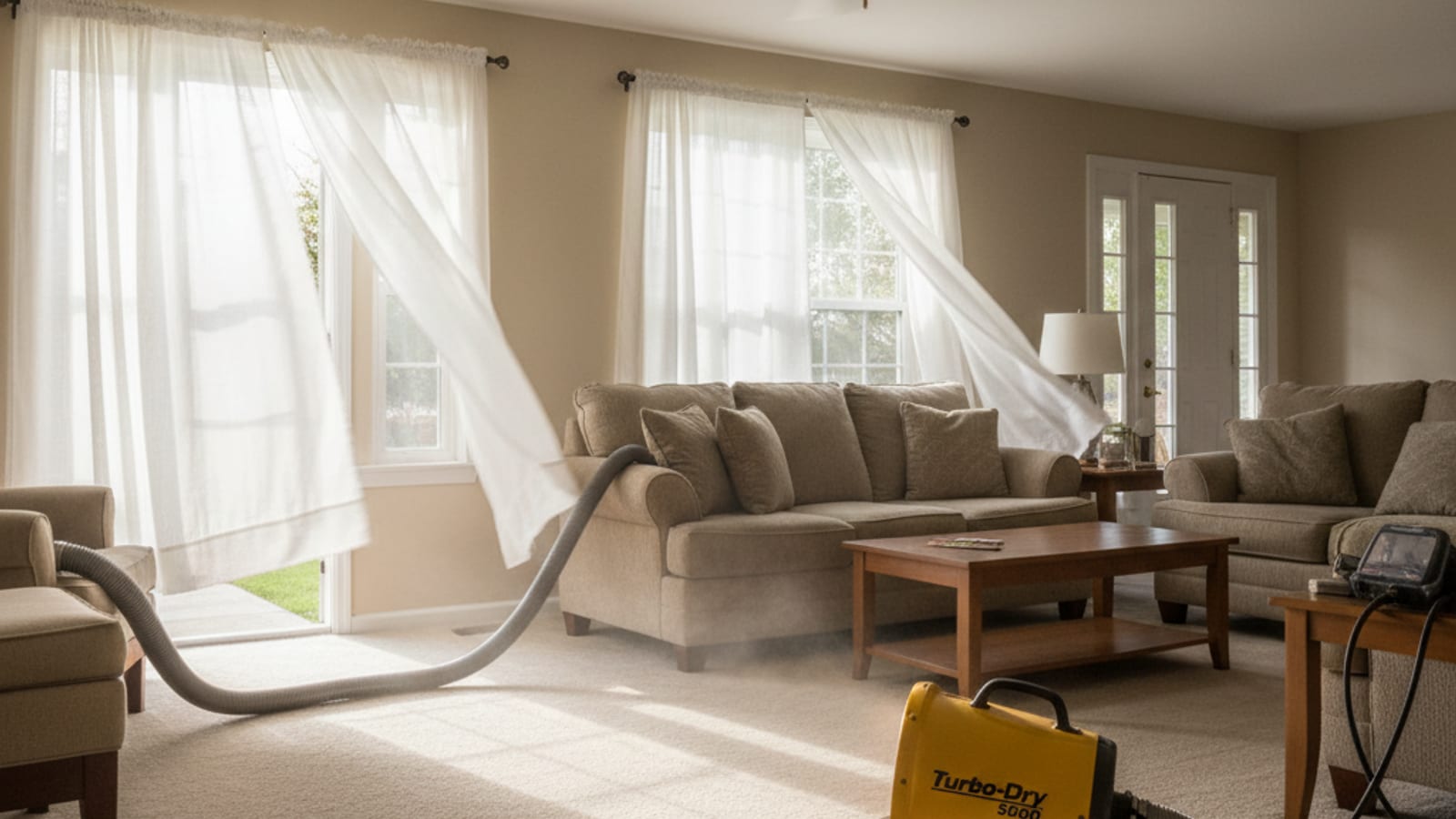
“How long will it take to dry?” is one of the two questions every carpet cleaning customer asks before we start. Here’s the realistic answer, and why it varies more than most cleaners admit.
The straight answer
4 to 6 hours in most San Diego homes with AC and normal airflow running. That covers maybe 80% of our jobs.
3 to 4 hours when we deploy commercial air movers and it’s a dry day.
6 to 8 hours on humid coastal mornings, older homes with poor airflow, or thick-pile carpets.
10 to 14 hours on worst-case combinations: plush wool, closed windows, no AC, high humidity. We try to avoid this by deploying equipment.
What controls dry time
Four things, roughly in order of impact:
1. How much water stayed in the carpet
The biggest variable, and most of it is down to the equipment used.
- Truck-mounted extraction (what we use): vacuum pulls ~95% of the injected water back out on the first pass. Carpet feels damp-to-touch afterward, not wet.
- Portable extraction (smaller pros, high-rise condos): pulls ~85%. Carpet feels noticeably wet for a few hours.
- Rental machines (grocery store): pulls ~70%. Carpet is soaked for a day or two.
- Shampoo + rug doctor bonnets: leaves the most moisture behind. Sometimes 30%+ of the water never comes back out.
If you’ve had DIY-level cleaning before and it took two days to dry, that’s why. Our truck-mount is the main reason our dry times are short.
2. Airflow across the surface
Moving air removes water faster than still air, by a wide margin. In order of effectiveness:
- Commercial low-profile air movers (yellow pyramid things): gamechanger
- Ceiling fans: roughly 40% improvement
- Box fans aimed across the floor: 30%
- HVAC running with a slightly cooler setpoint: 20%
- Open windows with a breeze: 20%
We bring air movers standard and deploy them on traffic lanes and known problem zones. If you see one blowing on your carpet when we leave, don’t unplug it early, and don’t move it. Let it run the 3–4 hours we recommend.
3. Humidity
Outdoor humidity is the second lever. Air already saturated with water can’t absorb more from your carpet. San Diego coastal marine layer mornings are the worst case: the air itself is 85%+ humid.
If you’re coastal (Encinitas, Pacific Beach, Coronado, Imperial Beach), book afternoon appointments when possible. Marine layer usually burns off by noon and the afternoon air can actually pull moisture from carpet.
Inland homes (Escondido, San Marcos, El Cajon) rarely have humidity problems. Dry inland air dries carpet fast.
4. Carpet construction
Thicker, denser, taller pile holds more water.
- Low-pile commercial loop (office carpet): 2–4 hours typical
- Medium-pile residential nylon: 4–6 hours
- Plush/frieze/saxony residential: 6–8 hours
- Wool (naturally absorbent): 8–12 hours, sometimes more
Thick pile is a feature, not a problem. It’s just a slower-drying feature. If you have deep plush carpet, plan for a whole-day commitment rather than a half-day.
How to speed it up after we leave
Three habits cut dry time in half:
Set the AC to 72°F
AC pulls moisture out of air as a side effect of cooling. With 72°F setpoint, the system runs more and dehumidifies as it goes. 68°F works better still but is usually too cold for comfort.
Run ceiling fans upstairs
Even if the cleaned room doesn’t have a ceiling fan, moving air in the ceiling level of the house creates a vertical air flow that lifts moisture out of the carpet and into the airstream. Any ceiling fan anywhere in the house on low is a help.
Open the floor registers and door gaps
Closed-off rooms dry slowly. Even a gapped door lets air circulate.
What to avoid for the first 4 hours
- Walking on the carpet in socks. Socks pick up residual moisture. Either go barefoot, wear shoe covers (we leave you some), or stay out of the cleaned rooms.
- Replacing furniture. If we moved chairs and end tables onto dry areas, leave them until the carpet feels fully dry. Furniture on damp carpet can leave rust marks from metal glides or water rings from wood legs.
- Running the cleaned rug back into heavy use. Let it set the pile first.
- Closing off the rooms. Leave doors open, let air flow through.
What you might see during drying
A couple of things that are normal but sometimes alarming:
- Light water ring at a stain location. This is “wicking,” residual stain rising to the surface as the carpet dries. This usually resolves as it fully dries; if it’s still there after 24 hours, call us back for a no-charge re-pass.
- Slight crunchy feel. Carpet fibers that have been fully rinsed can feel slightly crisp as they dry. Vacuuming lightly after full drying restores soft feel.
- Faint clean-carpet smell. Yes. That’s how carpet is actually supposed to smell: like fiber, not like perfume. Fragranced carpet “clean” smells are a cover for under-done cleaning.
When to call us back
We warranty our work. Call back for a no-charge re-clean if:
- A spot we treated rewicked and is visible after 24 hours
- You smell pet urine after a pet-odor job (we’ll come back and reinspect)
- Carpet doesn’t feel dry after 24 hours
- A section was missed
Real calls, real answers, no arguments. We want our work to hold.
The bottom line on dry time
For a typical three-bedroom San Diego home with our truck-mount and AC running: plan on 4–6 hours before the rooms are fully usable again. If you book a morning appointment, you’ll be back in the house by dinner.
Call (858) 925-5546 to schedule, or see the full carpet cleaning page for pricing and process details.