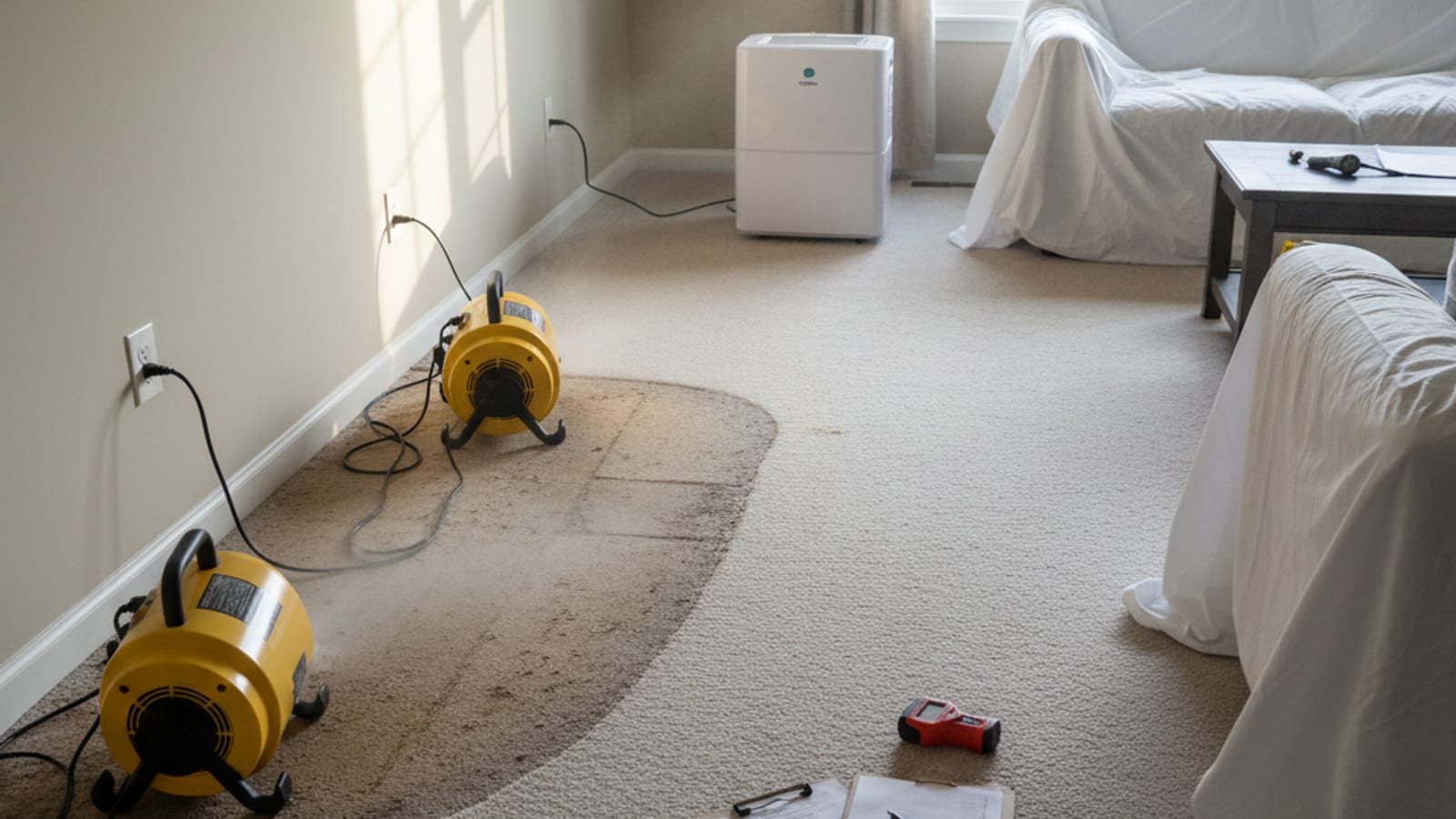
Water damage has the shortest decision window of anything we handle. Every hour you wait to act makes the problem meaningfully worse. Here’s the timeline from the moment water hits your carpet.
Hour 0–4: the save window
Clean water from a burst supply line, dishwasher overflow, or washing-machine hose failure is category 1 water. It’s safe to extract, and the carpet is almost always savable if you act fast.
In the first 4 hours:
- Water is still primarily in the carpet face yarn and upper pad
- Subfloor may be damp but not saturated in most residential installs
- No microbial growth yet (mold spores need 24–48 hours to activate)
- Extraction at this point removes 90%+ of the water
What you should do:
- Stop the water source if possible (shutoff valve, main water)
- Move anything that can move (furniture, boxes, electronics) off the carpet
- Lift any area rugs immediately and hang them over a railing or chair back
- Call a water mitigation pro (look for an IICRC-certified company)
- If safe, begin blotting with dry towels
What you should NOT do:
- Don’t run a home vacuum over wet carpet (will destroy the vacuum and spread the water)
- Don’t walk through the area in socks (pushes water deeper)
- Don’t assume carpet shampoo machines will do the job (they pull water at a rate of ~1/20th our truck mount)
- Don’t wait “to see if it dries on its own”
Hour 4–24: structural drying phase
Professional response in this window. We deploy commercial air movers and dehumidifiers to get moisture content back to baseline.
What we do:
- Thermal imaging to map every wet zone (including hidden wall voids)
- Moisture meter readings to establish baselines
- Lift carpet edges along affected walls, tuck pad back to expose underside
- Deploy 3–8 air movers depending on room size
- Place 1–2 commercial dehumidifiers
- Return daily to monitor moisture readings and adjust placement
By hour 24, water content in carpet face yarn is usually back near baseline. Pad takes longer.
Hour 24–48: the critical threshold
This is where the game changes. Mold needs three things: moisture, darkness, and organic material. Wet carpet + wet pad + wet subfloor checks all three boxes. At 48 hours, microbial growth activates.
Once mold is present, the categorization shifts:
- Category 1 → 2: once mold is detected, water is now gray water
- Health concern: airborne spores become a respiratory risk
- Scope expands: no longer just drying, but now also remediation
- Cost increases: often 3–5x the dry-only response cost
- Warranty issues: some homeowner policies exclude mold damage; some require mitigation within 72 hours to maintain coverage
The vast majority of “we should have called sooner” regrets in this industry come from the 24–48 hour window.
Hour 48–72: the decision point
At this stage, without professional mitigation, the decisions multiply:
Carpet face yarn
Usually salvageable with aggressive extraction and hot-water cleaning. Most nylon and polyester can survive up to 72 hours wet with cleaning.
Carpet pad
Usually needs replacement at this point. Saturated pad that’s been wet for 48+ hours grows mold in its interior where extraction can’t reach. At $1/sq ft to replace, it’s much cheaper than leaving it.
Subfloor
Plywood subfloor wet for 48+ hours may need drying with specialized equipment (dessicant dehumidifiers, sometimes demolition of affected areas if wet for 72+ hours). Concrete subfloor is more tolerant.
Wall base and drywall
Drywall wicks water up from saturated carpet. The bottom 4–12 inches of drywall is often compromised after 48 hours of wet carpet contact. Drywall replacement is another trade (not carpet cleaning).
Cabinet base and baseboards
Both are common secondary damage zones if the wet carpet touches them for extended periods.
Hour 72+: scope keeps growing
Every 24 hours past the 72-hour mark adds more to the scope. After a week:
- Active mold visible on carpet backing and pad
- Musty odor permanent in the affected area (requires air scrubbing and ozone treatment)
- Subfloor may need demolition in worst areas
- Adjacent wall finishes compromised
- HVAC system may have drawn spores into ductwork
What would have been a $1,500 mitigation at hour 4 becomes a $15,000+ remediation at day 10. This is why the industry uses the phrase “48-hour rule.”
Insurance: what to do first
Homeowner insurance typically covers sudden water damage (category 1) with proper documentation. It usually excludes gradual leak damage. The distinction matters.
Document:
- Photos of the water source
- Photos of the affected rooms before anyone touches anything
- Shutoff time if you know it
- Any prior leaks or known issues
Call your insurance company before you authorize major mitigation work. They’ll often have a preferred vendor list, but in most policies you have the right to choose a vendor of your own. Detailed documentation makes the claims process smoother.
What we provide for insurance claims:
- Thermal imaging scans
- Moisture meter daily logs
- Scope of work with line-item pricing
- Daily photo documentation
- Signed technician service reports
Gray and black water
Not all water damage is category 1.
Category 2 (gray water)
- Dishwasher or washing machine overflow
- Toilet overflow of clean water (urine-free)
- Water heater leak that has been standing for some time
Treatment: can often save the carpet, always replace the pad, antimicrobial treatment applied.
Category 3 (black water)
- Sewer backup
- Toilet overflow with waste
- Flood water from outside (storm drain, rising surface water)
- Saltwater intrusion
Treatment: carpet and pad both must be removed by health code. Subfloor sealed and decontaminated. No home remediation; this is professional-only.
Our water damage page covers all three categories and the protocols for each.
Same-day response
We dispatch water emergency calls ahead of all scheduled cleaning. Typical response time:
- Central San Diego: 1–2 hours
- North County coast: 2–3 hours
- East County: 2–4 hours
- South Bay: 2–3 hours
- Mountain communities: 3–6 hours (longer drive but we dispatch)
Call (858) 925-5546. Real human answers 24/7 for water emergencies. We’ll give you over-the-phone triage while we’re en route: what to move, what to avoid, how to turn off the source if you haven’t yet.
Prevention: what to check before the next big rain
San Diego gets heavy rain maybe six weeks a year. Before the rainy season:
- Test all water shutoff valves (make sure they actually turn)
- Inspect the water heater for any weeping at the base
- Check washing machine hoses and replace them every 5 years, braided-steel preferred
- Look under sinks for any rust or mineral staining on pipes
- Check the refrigerator ice-maker line for any bends or wear
- Clear the roof gutters to prevent overflow
- Verify that any sump pumps (few San Diego homes have them) work
Most water emergencies we respond to are preventable with 30 minutes of prep. Not all are (pipe failures happen), but many are.
The bottom line
If water is on your carpet right now, don’t wait to see. Call us. Early response saves the carpet, keeps mold off the call, and minimizes insurance complexity. The 48-hour rule is real and it’s expensive if you miss it.
(858) 925-5546. We answer. We dispatch. We’re there.